
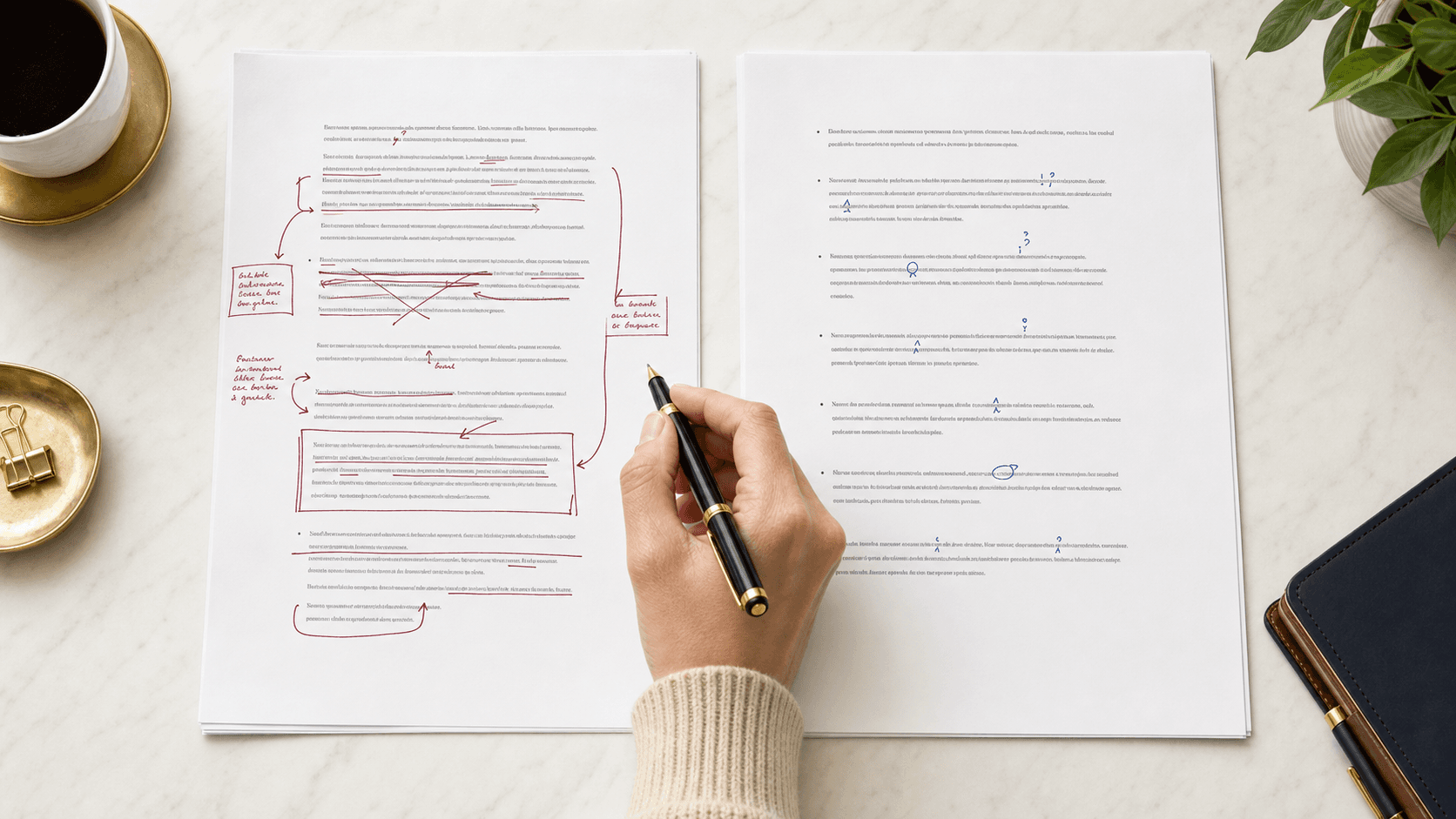
AI proofreading vs human proofreading: the short answer
AI proofreading can be useful for a quick first pass on spelling, grammar, repeated words, and obvious sentence problems. Human proofreading is stronger when meaning, tone, context, confidentiality, formatting, document-wide consistency, and final judgment matter.
The safest workflow is not AI or human in isolation. Use AI cautiously for low-risk early checks, then use professional proofreading services for important academic, business, manuscript, application, or submission-ready documents.
What AI proofreading tools can catch
AI tools can identify many visible language issues quickly. They may flag spelling variants, repeated words, missing punctuation, grammar patterns, wordiness, and sentences that could be easier to read.
They are useful when you need a first pass before sharing a draft. Our free AI editing tool is designed for that early review stage, not as a replacement for a human final check.
- Obvious spelling and punctuation issues
- Repeated words or simple grammar patterns
- Overlong sentences that may need attention
- Possible tone or clarity issues in short text
What human proofreaders catch that AI can miss
A human proofreader reads the document as communication. They can ask whether a correction preserves the writer's meaning, whether a term is discipline-specific, whether a business claim has been changed accidentally, and whether a sentence is technically correct but unsuitable for the reader.
Human review is especially important for documents with confidential information, citation rules, tables, figures, formatting requirements, or high-stakes consequences. Our editorial policy explains the boundaries of responsible human editing.
- Meaning changes introduced by automated suggestions
- Inconsistent terms across chapters or sections
- Tone that does not fit the audience
- Formatting, captions, references, and final-file issues
- Questions that require author confirmation rather than automatic rewriting
AI proofreading vs human proofreading comparison
Use this comparison before deciding how much review your document needs.
| Need | AI proofreading | Human proofreading |
|---|---|---|
| Speed | Fast for short text | Depends on length, scope, and turnaround |
| Context | May miss discipline or audience nuance | Can preserve meaning and reader expectations |
| Confidentiality | Depends on the tool and its data handling | Handled through the service's submission workflow |
| Formatting | Limited for complex files | Can review supplied document presentation |
| Final accountability | Suggestions need human approval | Corrections still require author approval |
Match the proofreading method to the document risk
The right choice depends on what can go wrong if an error remains. A short internal note may only need a fast cleanup. A thesis chapter, proposal, CV, manuscript, or translated document can carry higher risk because small language changes may affect meaning, credibility, compliance with instructions, or reader trust.
For academic work, check your institution's rules before using any AI tool, especially if the text includes unpublished research, participant information, supervisor comments, or assessment material. For business and application documents, consider whether the tool is allowed to process client information, financial figures, personal data, or confidential strategy.
| Document type | AI may help with | Human review is stronger for |
|---|---|---|
| Short draft text | Obvious grammar, spelling, and repeated words | Tone, audience fit, and final judgment |
| Thesis or dissertation | Early low-risk language prompts | Meaning, citations, formatting, policies, and consistency across chapters |
| Business proposal | Simple sentence cleanup | Client names, figures, scope wording, version control, and approved terminology |
| CV or resume | Typos and wordiness | Truthful positioning, chronology, role language, and recruiter readability |
| Translated English | Awkward phrasing prompts | Meaning preservation, terminology, and places needing source-language confirmation |
What to check before accepting an AI proofreading suggestion
Do not accept suggestions in bulk. Read each change against the original sentence, the surrounding paragraph, and the document purpose. A correction can be fluent and still be wrong for the writer's meaning, discipline, client, or submission rule.
Pay close attention to cautious academic wording, technical terms, names, dates, numbers, citations, headings, captions, and any sentence that describes responsibility, limitations, results, prices, or qualifications. Those are places where a small automated rewrite can create a larger problem.
- 01Compare the suggested sentence with the original meaning.
- 02Check whether technical terms, names, numbers, and citations stayed unchanged.
- 03Reject any suggestion that strengthens a claim beyond the evidence.
- 04Search the document for related terms so one accepted change does not create inconsistency.
- 05Use a final human pass when the document is important, confidential, or submission-ready.
Optional future AI vs human proofreading study structure
This article is prepared for a future AI vs human proofreading study, but no results are published here because no anonymized test dataset has been supplied. Publishing numbers without real documents, a defined method, and repeatable scoring would be misleading.
A legitimate study would need anonymized sample documents, clear consent and confidentiality controls, a fixed error taxonomy, blinded review where practical, and documented scoring rules before any statistics are added.
| Study element | Required before publishing | Status |
|---|---|---|
| Sample documents | Anonymized academic, business, manuscript, application, and translated text examples | Manual data required |
| Error categories | Grammar, punctuation, meaning, terminology, references, tables, figures, formatting, and confidentiality risks | Framework drafted |
| Review process | Defined AI tool settings and independent human review process | Manual method required |
| Scoring | Transparent scoring rules for caught, missed, introduced, and inappropriate corrections | Manual validation required |
A safe proofreading workflow
Start by cleaning obvious errors yourself. Use AI only on text you are allowed to submit to that tool, and review every suggestion before accepting it. Then use a human final review when the document must preserve exact meaning, confidential information, citation integrity, or institutional requirements.
- 01Freeze the draft version you want reviewed.
- 02Run a low-risk first pass for obvious language issues.
- 03Reject suggestions that change facts, claims, tone, or terminology.
- 04Use a human proofreader for the final document.
- 05Review the returned file before submission.
When human proofreading is the better choice
Choose human proofreading when the document is academic, professional, client-facing, application-related, confidential, or close to final submission. AI can assist the early clean-up, but final judgment belongs with a person who can read context and leave questions where the author must decide.
Ready for a final review? Upload your document securely or compare pricing before you begin.
Questions about this topic
Is AI proofreading enough for important documents?
Usually not. AI can help with a first pass, but important documents benefit from human review for meaning, tone, confidentiality, formatting, and document-wide consistency.
Can AI proofreading change my meaning?
Yes. Automated suggestions can make a sentence smoother while changing the writer's intended meaning, technical term, claim strength, or citation relationship.
Should I use AI before hiring a proofreader?
You can use AI cautiously for low-risk early checks, but review every suggestion and avoid uploading confidential or restricted material to tools that are not permitted.