
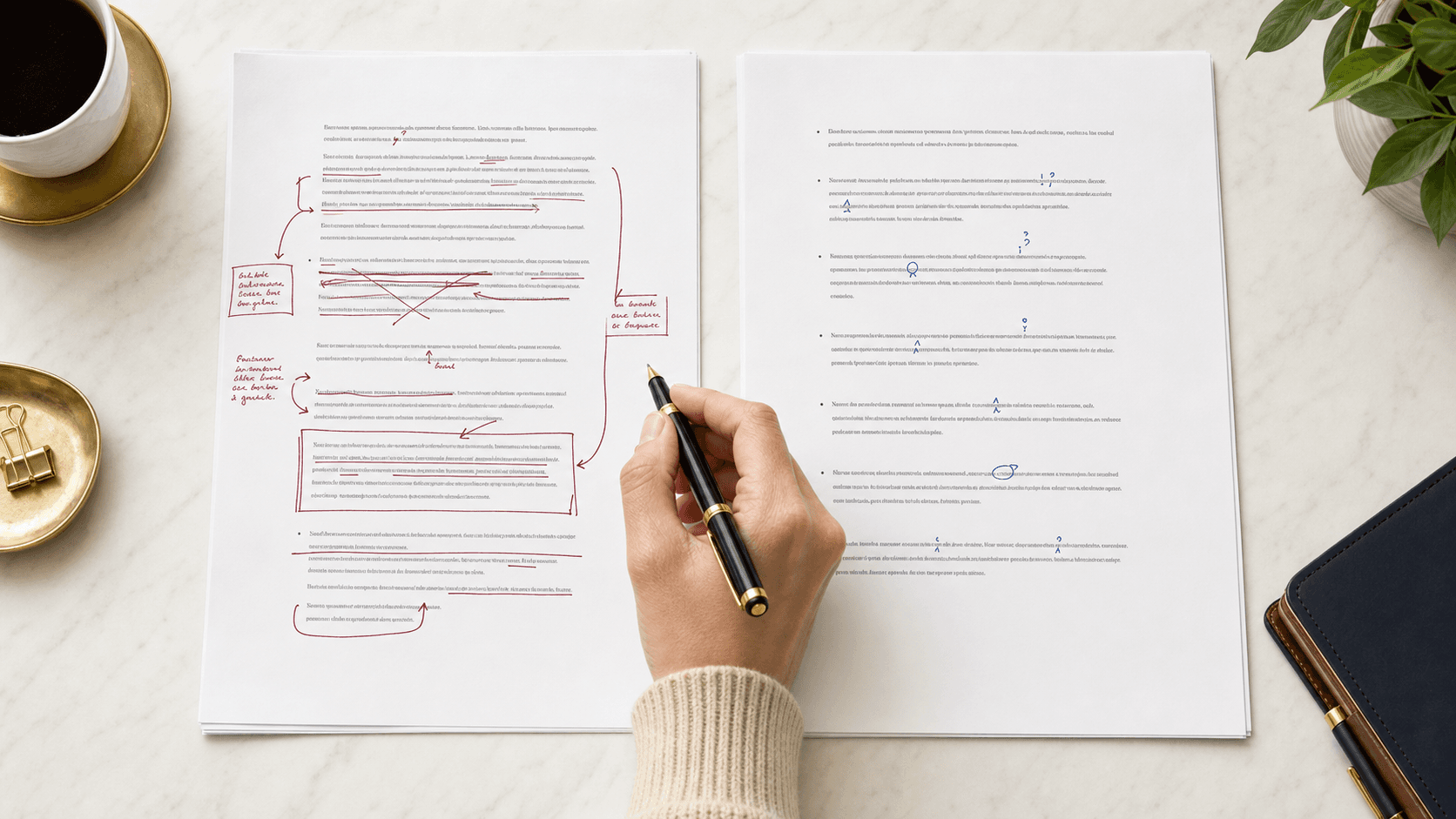
Why a single draft is never enough
Writing and editing require two entirely different mindsets. When you write, your goal is to get ideas onto the page. When you edit, your goal is to make those ideas comprehensible to a reader who doesn't live inside your head.
If you are searching 'edit my paper online', you've likely reached the point where you can no longer objectively see the flaws in your own writing. This guide will walk you through a professional three-pass editing system you can apply to any academic paper, essay, or thesis.
Step 1: Edit for structure and argument (The Macro Edit)
Never start by fixing commas. If a paragraph doesn't belong in the paper, fixing its punctuation is a waste of time. Start by looking at the skeleton of your document.
Does your introduction clearly state your thesis or research question? Does every subsequent section logically follow from the previous one? Does your conclusion synthesize the evidence rather than just summarizing it?
- Check that every paragraph supports your central thesis.
- Ensure section headings accurately reflect the content beneath them.
- Look for 'orphaned' ideas that need better integration or removal.
Step 2: Edit for paragraph flow and academic tone (The Micro Edit)
Once the structure is sound, zoom in on how your sentences connect. Academic writing should be formal, objective, and precise. Avoid overly complex vocabulary just to sound 'smart'—clarity is the ultimate goal of academic writing.
- 01Read your paper aloud. If you stumble over a sentence, it's too long or awkwardly constructed.
- 02Check transitions. Words like 'furthermore', 'however', and 'consequently' should bridge ideas logically.
- 03Eliminate passive voice where possible. 'The study was conducted by researchers' is weaker than 'Researchers conducted the study'.
Step 3: Proofread for grammar, spelling, and formatting
Only when you are completely satisfied with the content should you begin proofreading. This is the final polish to ensure typographical errors don't undermine your credibility.
- Run a spell-check, but don't rely on it exclusively (it won't catch 'their' vs 'there').
- Verify that your citations and references strictly follow your required style guide (APA, MLA, Chicago).
- Check formatting consistency: margins, fonts, line spacing, and page numbers.
Online AI tools vs Human editors
There are many online tools available to help you edit your paper. AI grammar checkers are excellent for catching basic typos and repetitive phrasing instantly. However, they lack human context.
An AI cannot tell you if your argument is logically sound, if your tone is appropriate for a specific journal, or if you've fundamentally misunderstood a theoretical concept. They are a great first pass, but not a final solution for high-stakes documents.
Try our free AI tool
Want a quick check before a deep edit? Try our free AI Editing Tool to catch basic surface-level errors instantly.
When to hire a professional to edit your paper
Sometimes, you are simply too close to the text to edit it effectively. Hiring a professional human editor is an investment in your academic success. A professional editor brings fresh, objective eyes and deep knowledge of academic conventions.
If your grade, degree, or publication depends on this paper, professional editing ensures your ideas are judged on their merit, not on language errors.
Questions about this topic
Is it ethical to have someone edit my paper online?
Yes, provided the editor focuses on language, clarity, structure, and formatting. Ethical academic editing does not involve ghostwriting, altering data, or generating original academic content for you.
How much does it cost to edit a paper?
Costs typically depend on word count and turnaround time. Most professional services charge per word. You can use our pricing calculator to get an exact estimate.