
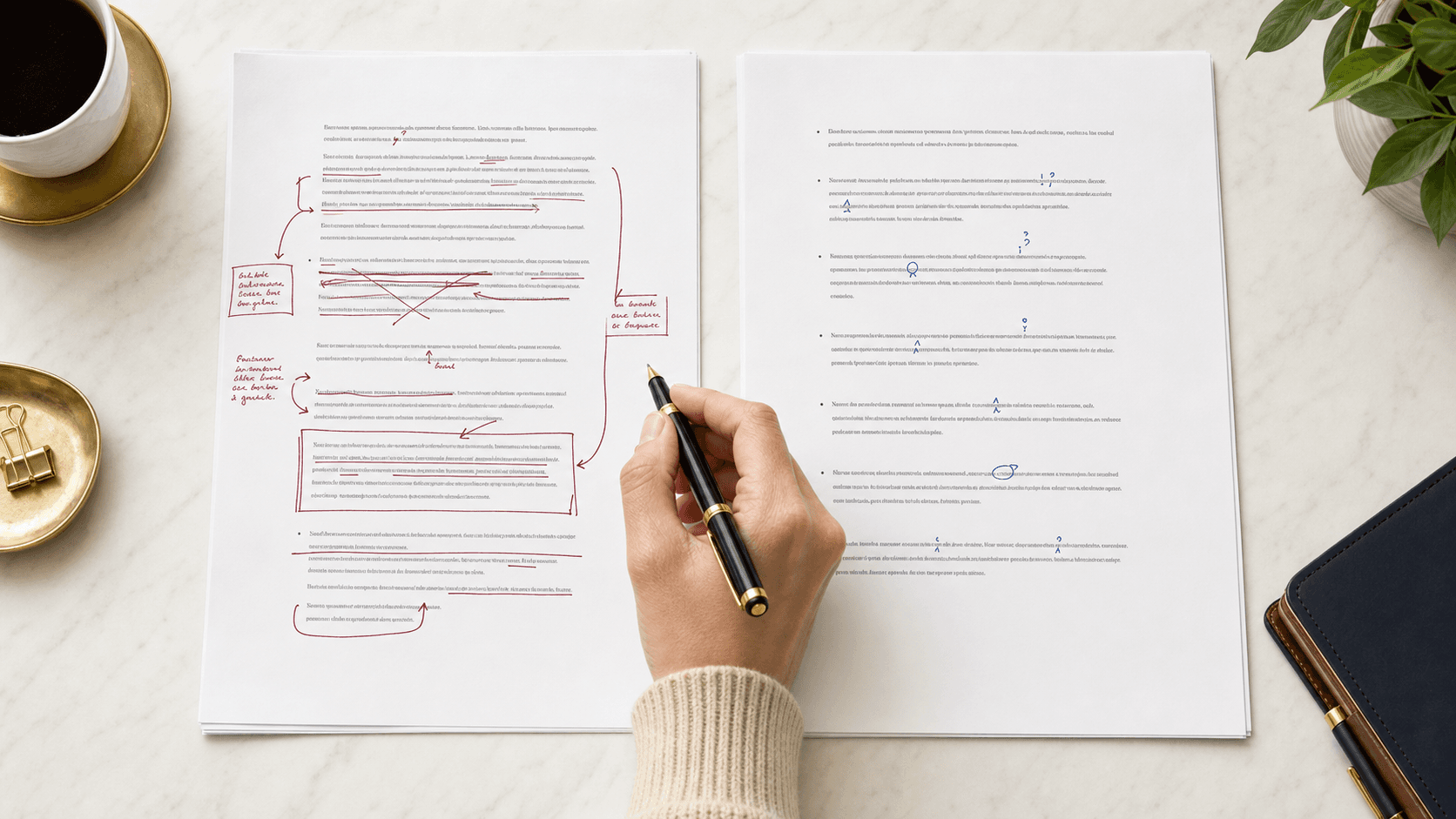
Editing vs proofreading: the quick answer
The difference between editing vs proofreading is the level and timing of the review. Editing improves meaning, structure, clarity, flow, tone, and sentence construction. Proofreading happens after those decisions are settled and checks the final draft for grammar, spelling, punctuation, consistency, and presentation errors.
Choose editing when a reader may struggle to follow your argument, when sections feel uneven, or when the language needs substantial refinement. Choose proofreading when the document already says what it needs to say and you want a careful final check before submission, publication, or delivery.
Quick decision rule
If you are still changing ideas, sections, or paragraph order, choose editing. If the content is complete and only final errors remain, choose proofreading.
Editing vs proofreading: a practical comparison
Editing and proofreading are related, but they solve different problems. The University of North Carolina Writing Center describes them as separate stages of revision: editing considers content, organization, paragraph structure, clarity, style, and citations, while proofreading focuses on final surface errors. Its editing and proofreading guide is a useful independent overview of the distinction.
| Question | Editing | Proofreading |
|---|---|---|
| Main purpose | Improve how the document communicates | Remove final errors and inconsistencies |
| Best stage | After a complete draft, before finalization | After editing and all major revisions |
| Typical focus | Structure, clarity, flow, tone, wording | Grammar, spelling, punctuation, formatting |
| Scale of changes | Sentence, paragraph, and section level | Word, sentence, and presentation level |
| Writer involvement | May require decisions on comments or larger revisions | Usually requires fewer content decisions |
| Best for | Drafts that need stronger communication | Complete drafts that need a final quality check |
What professional editing services improve
Editing begins with the reader's experience. An editor asks whether the purpose is clear, whether each section belongs where it appears, and whether the wording expresses the writer's intended meaning. This can involve moving or reshaping sentences, tightening paragraphs, improving transitions, and flagging claims that need clarification.
For academic editing, the review may focus on argument flow, scholarly tone, terminology, evidence language, headings, and citation consistency. Our academic editing service is intended for essays, theses, dissertations, and research papers that need more than correction of surface errors.
- Clarifying sentences that are grammatically correct but difficult to understand
- Improving paragraph order and transitions between ideas
- Reducing repetition, vague language, and unnecessary qualification
- Making tone appropriate for an academic, business, publishing, or application audience
- Checking terminology, headings, and document-wide consistency
- Leaving comments where the writer—not the editor—must make the final decision
What professional proofreading services check
Proofreading is the last quality-control stage. It is most effective after the writer has approved the content and no longer expects major restructuring. A proofreader reads slowly and systematically for mistakes that can distract a reader or make a finished document appear careless.
Purdue University's Online Writing Lab recommends approaching proofreading with a defined error list, reading slowly, and checking the document from a fresh perspective. Its proofreading guidance also notes that reading aloud or reading sentences in reverse order can make familiar errors easier to notice.
Our professional proofreading service is designed for final drafts that need grammar, punctuation, spelling, consistency, and light readability corrections before they are shared.
- Spelling, grammar, punctuation, capitalization, and typographical errors
- Consistency in abbreviations, numbers, dates, hyphenation, and terminology
- Repeated or missing words and small sentence-level problems
- Heading styles, lists, captions, labels, and reference presentation
- Obvious formatting issues introduced during the final revision or export
When a document may need both editing and proofreading
Many important documents benefit from two distinct passes. The first pass addresses structure, clarity, tone, and sentence-level communication. The second pass checks the approved version for errors introduced during revision and for inconsistencies that only become visible when the document is read as a finished whole.
A thesis may need academic editing while the argument and chapters are still being refined, followed by proofreading after the author accepts the changes. A business proposal may need substantial message editing before stakeholder review, then a final proofread after names, figures, dates, and pricing have been confirmed.
Trying to combine both stages too early can waste effort. There is little value in perfecting punctuation in a paragraph that will later be removed, rewritten, or moved to another section.
Academic, business, manuscript, and application examples
The correct service depends less on the document label than on its condition. A research article with a strong study but an unclear discussion needs editing. The same article, after revision and author approval, may need only academic proofreading before submission.
For reports, proposals, and other professional documents, business editing can strengthen reader focus before proofreading begins. Applications may also need structural support when the central message or organization is still developing.
| Document | Choose editing when… | Choose proofreading when… |
|---|---|---|
| Thesis or research paper | The argument, chapter flow, or scholarly language is unclear | The content is final and citations, grammar, and formatting need checking |
| Business report or proposal | The message is wordy, poorly ordered, or inconsistent | Figures and content are approved and the final version needs correction |
| Book or manuscript | Pacing, chapter organization, voice, or readability needs work | The edited manuscript is ready for a final error check |
| Application or personal statement | The focus, examples, and structure do not yet make a clear case | The statement is complete and needs a careful final polish |
How to choose between copy editing vs proofreading
People sometimes use copy editing as a broad term for sentence-level editing. In practice, copy editing vs proofreading still follows the same sequence: copy editing improves language and consistency; proofreading checks the final version after those changes have been accepted.
Use the questions below before selecting a service. If you answer yes to the first three, editing is probably the better starting point. If you answer yes mainly to the last two, proofreading may be enough.
Price also depends on the word count, turnaround, and depth of review. Use the editing and proofreading pricing calculator for an initial estimate, or submit the document if you need help deciding which level is appropriate.
- 01Are any sections difficult to follow or noticeably repetitive?
- 02Does the tone feel uneven, informal, or unsuitable for the intended reader?
- 03Are you still changing the argument, examples, or section order?
- 04Has the document already been edited and approved?
- 05Is your main concern final grammar, spelling, punctuation, and formatting?
Final choice: editing vs proofreading
Choose editing when the document still needs clearer thinking, organization, tone, or sentence-level communication. Choose proofreading when the content is final and the remaining task is careful correction. Some high-stakes documents need both stages in sequence.
Still unsure which service you need? Submit your document and we’ll help you choose the right level of review.
Questions about this topic
Is editing better than proofreading?
Neither is universally better. Editing is the right choice when structure, clarity, tone, or sentence construction needs improvement. Proofreading is better for a complete, well-developed draft that only needs final corrections. The condition of the document—not its importance—should determine the service.
Can proofreading improve awkward sentences?
A proofreader may make light wording corrections when a sentence contains an obvious error. If awkward phrasing, unclear meaning, repetition, or weak transitions appear throughout the document, editing is more appropriate because the work goes beyond final error correction.
What is the difference between copy editing and proofreading?
Copy editing improves language, consistency, grammar, tone, and readability before the document is finalized. Proofreading follows copy editing and checks the approved version for remaining errors, formatting inconsistencies, and mistakes introduced during the revision or production process.
Should a thesis be edited or proofread?
A thesis should be edited if its argument, chapter flow, scholarly tone, or sentence clarity still needs work. It should be proofread when the content and structure are final. Many theses benefit from editing first and a separate proofread before submission.
How do I know whether my document needs both services?
Choose both when the draft requires meaningful language or structural improvement and will later need a clean final check. Separate passes are especially useful for theses, manuscripts, reports, and proposals because revisions can introduce new inconsistencies after editing.