
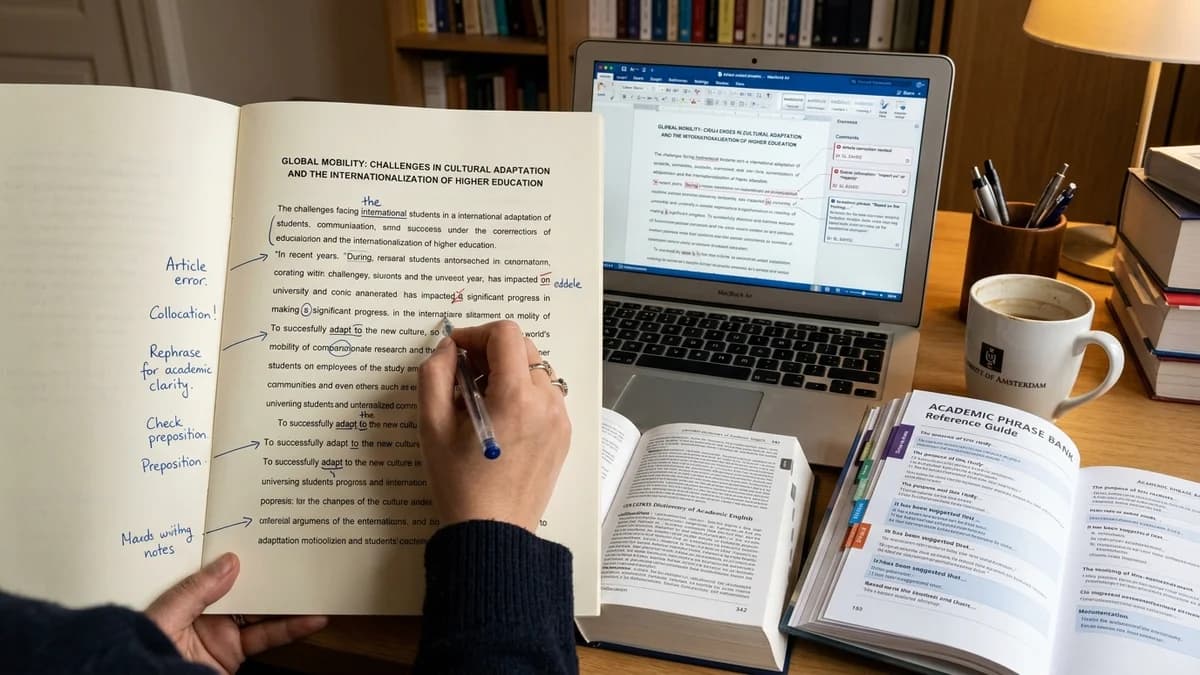
Why English academic writing poses unique hurdles for non-native authors
Non-native English (ESL/EFL) researchers produce groundbreaking research, but journal peer reviewers frequently reject submissions citing 'poor English language expression' or 'unnatural phrasing.' Academic English operates under stringent structural conventions that do not correlate directly with conversational fluency: specific article placement, fixed prepositional collocations, cautious hedging, and disciplinary passive voice.
Peer reviewers reading rapidly will often dismiss a manuscript if sentence-level ambiguities obscure experimental methods or statistical claims. Professional academic proofreading bridges this gap, refining syntax into idiomatic, native-level academic prose without altering technical conclusions or experimental data.
The Impact of Language Quality on Peer Review
Peer-reviewed journals index papers based on clarity. Eliminating awkward syntax and language errors allows peer reviewers to evaluate your scientific contribution on its merits rather than struggling through linguistic ambiguities.
Definite and indefinite article rules in scientific and academic writing
Article errors ('the', 'a', 'an', or zero article) represent the single most prevalent challenge for authors whose native languages lack articles (such as Chinese, Japanese, Korean, Russian, and Slavic languages).
In scientific prose, the definite article 'the' specifies a singular or plural noun known to the reader, previously introduced, or unique. Use 'a' or 'an' when introducing a non-specific countable noun for the first time. Uncountable mass nouns (e.g., 'information', 'evidence', 'software', 'equipment') never take indefinite articles and rarely take plural forms.
| ESL Error Example | Native Academic Revision | Grammatical Rule |
|---|---|---|
| The researcher provided a valuable research on the topic. | The researcher provided valuable research on the topic. | 'Research' is an uncountable noun in English; it cannot be preceded by 'a' or pluralized to 'researches'. |
| Data was gathered from participants. | Data were gathered from participants (in formal science) OR The data were gathered... | In formal academic prose, 'data' is treated as plural (singular: 'datum'). Adding 'the' is necessary if referring to specific experimental data. |
| We measured temperature of solution. | We measured the temperature of the solution. | Specific measurable attributes of an identified experimental specimen require definite articles. |
Subject-verb agreement with collective, mass, and intervening phrases
Subject-verb agreement errors occur when complex modifiers intervene between the grammatical head noun and the predicate verb. Authors instinctively match the verb to the nearest noun rather than the true subject of the clause.
- Intervening Prepositional Phrases: 'The quality of these experimental samples was [not were] evaluated.' The true subject is singular 'quality', not plural 'samples'.
- Collective Nouns: Words such as 'number', 'majority', and 'proportion'. When preceded by 'a' ('a number of studies'), the verb is plural ('a number of studies demonstrate'). When preceded by 'the' ('the number of participants'), the verb is singular ('the number was small').
- Compound Subjects with Disjunctions: When subjects are linked by 'either...or' or 'neither...nor', the verb agrees with the subject closest to it: 'Neither the supervisor nor the research assistants were informed.'
Preposition collocations and academic phrase bank idioms
Prepositions cannot be translated literally across languages because their academic usage is governed by arbitrary collocation rules. Using an incorrect preposition signals non-native authorship and confuses meaning.
| Incorrect / Unnatural Phrasing | Correct Academic Collocation | Collocation Context |
|---|---|---|
| Participate on the conference | Participate in the conference | Engagement in events and processes |
| Dependent from external factors | Dependent on / upon external factors | Conditional reliance |
| Consistent to prior findings | Consistent with prior findings | Conformity with literature |
| Investigate about the mechanism | Investigate the mechanism | 'Investigate' is a transitive verb taking a direct object without prepositions |
| In the other hand | On the other hand | Fixed contrastive idiom |
Sentence boundary errors: run-ons, comma splices, and sentence length
Academic writing across Romance languages (Spanish, French, Italian) and German frequently favours long, complex, multi-clause periods. In English academic writing, sentences exceeding 35 words become cognitively taxing and often incur comma splices.
A comma splice occurs when two independent clauses are joined solely by a comma: 'The sample size was limited, however, the findings remain statistically significant.' In English, an adverbial conjunction such as 'however' cannot join independent clauses with a comma alone. Use a semicolon and comma: 'The sample size was limited; however, the findings remain statistically significant' or divide the thought into two sentences.
False friends and direct translation calques
False friends are words that resemble vocabulary in the author's native tongue but carry distinct or inappropriate meanings in formal English academic prose:
- 'Eventually' vs 'Possibly': Authors from French or Spanish linguistic backgrounds often use 'eventually' to mean 'potentially' or 'in case of', whereas English 'eventually' exclusively means 'in the end after a period of time'.
- 'Actual' vs 'Current': In many European languages, 'actuel' or 'actual' means 'present-day'. In English, 'actual' means 'real' or 'factual'. Use 'current' or 'present' when discussing contemporary data.
- 'Aspect' vs 'Point of View': Using 'from our aspect' instead of the standard 'from our perspective' or 'in our view'.
- 'Pretend' vs 'Intend': Using 'we pretend to demonstrate' (translating French 'prétendre' or Spanish 'pretender') instead of 'we intend to demonstrate' or 'we aim to show'.
Maintaining formal academic register: hedging and voice
Academic English employs cautious attribution ('hedging') to avoid making overextended claims that peer reviewers will challenge. Non-native writers often oscillate between overly absolute assertions ('This proves that...') and excessively informal phrasing ('We noticed that...').
Replace absolute terms with precise epistemic markers: 'These findings suggest...', 'The data indicate a probable correlation...', or 'This pattern appears consistent with...'. Additionally, while first-person pronouns ('we investigated') are accepted in introductory and discussion sections, passive voice remains appropriate in methodology sections to maintain focus on the experimental protocol rather than the researchers.
Human translation review vs automated translation tools
While automated AI translation and grammar tools catch simple typos, they routinely corrupt specialist academic arguments. AI engines frequently introduce hallucinated synonyms, misinterpret technical terminology (such as translating medical or engineering terms literally), and strip necessary academic hedging.
Our translation review services and dedicated academic editing team ensure that subject-matter specialists review your text. An experienced human editor understands both your technical discipline and English stylistic requirements, preserving your exact scientific voice.
Questions about this topic
Can academic editing guarantee journal publication?
No ethical editorial service can guarantee acceptance by a peer-reviewed journal. Publication decisions depend on study methodology, novelty, data validity, and journal scope. Professional editing eliminates language and formatting barriers so your research is judged fairly on its academic merit.
Should I mention in my submission that my paper was professionally edited?
Many international journals welcome an acknowledgment noting that the manuscript underwent professional language editing by native English specialists. Some journals even request an editorial certificate, which our team provides upon request.
How does ESL editing handle mathematical equations and statistical notations?
Editors preserve all equations, formulas, and statistical values (p-values, degrees of freedom, sample sizes) exactly as written, verifying only that standard italicisation and spacing conventions (e.g., italics for variables like p, r, t) are maintained.
What is the difference between translation review and editing?
Translation review compares the English draft with the original language source or heavily polishes rough translations for idiom accuracy. Academic editing works on a draft written directly in English, enhancing clarity, tone, flow, and scholarly formatting.