
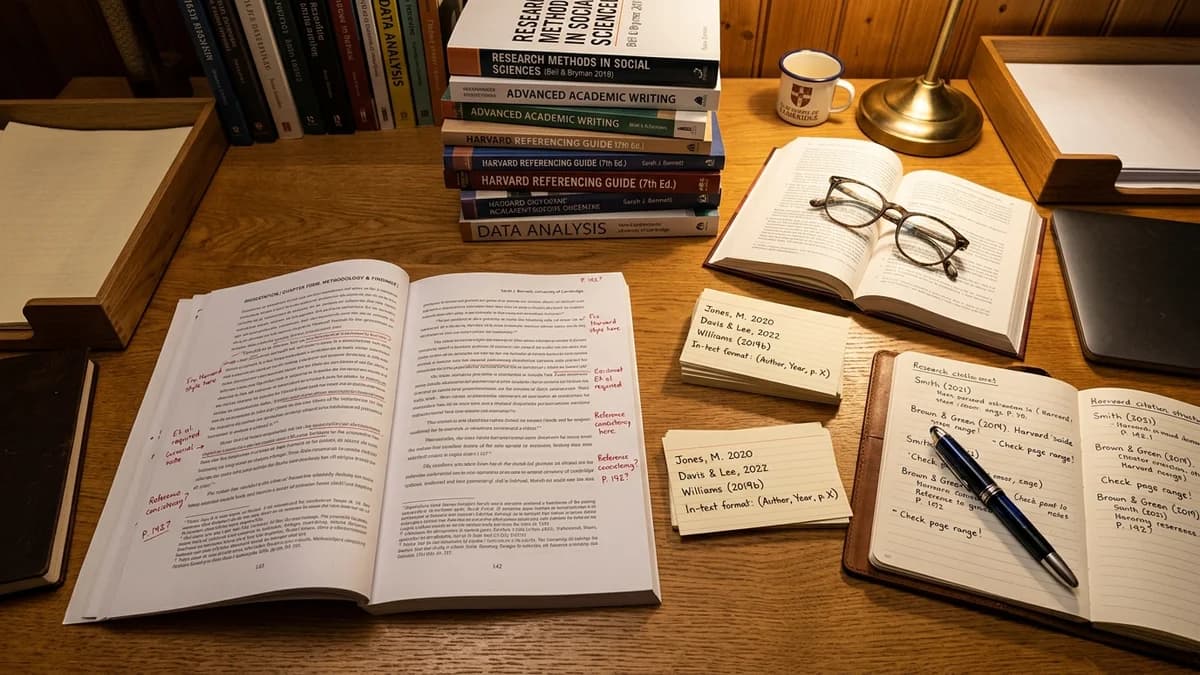
What is Harvard referencing and why does it vary across universities?
Harvard referencing is an author-date bibliographic system used extensively across United Kingdom, Australian, Canadian, South African, and European universities. Unlike APA or Chicago, there is no single central governing organization or official manual that defines 'standard' Harvard referencing; instead, institutional style guides (such as Cite Them Right, Leeds, Imperial, Monash, and Anglia Ruskin) establish slight variations in punctuation, capitalisation, and date placement.
Despite these institutional nuances, the core principles of Harvard referencing remain uniform: every source mentioned in your text must appear in an author-date parenthetical citation, and every in-text citation must correspond to an alphabetically organized reference list at the end of the document. Understanding the standard conventions prevents costly grade deductions and ensures publication readiness.
Golden Rule of Harvard Style
Because Harvard style has institutional dialects, always consult your department's designated guide (frequently Cite Them Right in the UK). Once you establish a punctuation convention for dates or initials, apply it consistently across all entries.
In-text citation rules: author, year, and page coordinates
In-text citations in Harvard style provide concise attribution within the body of your prose. Citations take two structural forms: parenthetical (where both author and year sit within parentheses) and narrative (where the author's name forms part of the sentence structure and only the year follows in parentheses).
When directly quoting, paraphrasing specific technical data, or citing a contentious claim, page numbers are mandatory. In standard Harvard conventions, page numbers are denoted by 'p.' for a single page or 'pp.' for a page span, separated from the year by a comma or colon depending on university house style.
- Parenthetical Citation (Single Author): (Davies, 2023, p. 45) or (Davies 2023: 45)
- Narrative Citation (Single Author): As Davies (2023, p. 45) argues, institutional governance...
- Two Authors: Always link both surnames with 'and' (not an ampersand) in British/Australian Harvard: (Davies and Campbell, 2024, pp. 112-114).
- Direct Quotation: 'Statistical models require clean inputs' (Foster, 2022, p. 19).
Building an error-free Harvard reference list
A Harvard reference list sits at the conclusion of your document, arranged in alphabetical order by the first author's surname. Unlike a general bibliography that lists background reading, a Harvard reference list contains only sources cited within the text. The fundamental building blocks follow: Author Surname, Initials. (Year of publication) Title. Edition (if not first). Place of publication: Publisher.
| Source Type | Standard Harvard Citation Pattern | Concrete Example |
|---|---|---|
| Printed Book | Surname, Initials. (Year) Title in italics. Edition. Place: Publisher. | Bryman, A. (2016) Social research methods. 5th edn. Oxford: Oxford University Press. |
| Journal Article | Surname, Initials. (Year) 'Title of article in quotes', Journal Name in italics, Volume(Issue), pp. page range. doi: number. | Saunders, M. and Lewis, P. (2022) 'Methodological rigor in business dissertations', Journal of Management Education, 36(4), pp. 410-428. doi: 10.1177/10525629221088219. |
| Edited Book Chapter | Surname, Initials. (Year) 'Chapter title', in Editor Surname, Initials. (ed.) Book title in italics. Place: Publisher, pp. page range. | Garrow, V. (2021) 'The psychology of assessment', in Martin, G. (ed.) Organizational Behavior. London: Routledge, pp. 78-95. |
| Website / Online Report | Corporate Author. (Year) Title of report in italics. Available at: URL (Accessed: Day Month Year). | Bank of England. (2024) Monetary policy summary and minutes. Available at: https://www.bankofengland.co.uk/monetary-policy/2024 (Accessed: 14 October 2026). |
The 7 most frequent Harvard referencing errors caught during proofreading
During academic proofreading, our editorial desk identifies persistent errors that compromise referencing consistency. Here are the top seven issues to eliminate:
- 01Missing access dates for websites: Web URLs change or expire; Harvard style mandates '(Accessed: Day Month Year)' for every electronic page.
- 02Inconsistent author-year punctuation: Mixing '(Smith, 2024)', '(Smith 2024)', and 'Smith (2024)' arbitrarily within the same chapter.
- 03Mismatch between in-text citations and reference list: Sources cited in the text missing from the bibliography, or reference list entries never cited in the body.
- 04Ampersand misuse in British Harvard: Using '&' instead of writing out 'and' in text citations in UK and Australian academic programs.
- 05Full author first names in reference list: Harvard uses initials only ('Davies, P. M.'), never full names ('Davies, Peter Mark').
- 06Incorrect et al. punctuation: Writing 'et. al.', 'et al', or 'et, al.' instead of the standard 'et al.'.
- 07Omission of chapter page ranges: Listing an edited book chapter without specifying the chapter's start and end pages in the collection.
Punctuation and italicisation across Harvard source types
Italicisation provides a visual cue distinguishing standalone containers (books, journals, reports, websites) from subordinate parts (article titles, chapter titles). In Harvard style, book titles and journal titles are italicised, while article titles and chapter titles are placed inside single quotation marks without italics.
Ensure that journal volume numbers are stated clearly alongside issue numbers in parentheses—such as '24(3)'. Page ranges must include both numbers joined by an en-dash or hyphen, preceded by 'pp.' for articles and chapters.
Why citation generators fail on Harvard referencing
Automated reference generators scrape metadata from websites and academic databases, but they lack human discernment. When scraping publisher websites, generators often mistake publication dates for copyright dates, fail to detect edition numbers, omit editor details, and misclassify government white papers as commercial blog posts.
Automated tools also cannot cross-check whether every cited reference exists in your bibliography. A human editor conducting an academic proofread or dissertation proofread verifies name spellings across chapters, confirms chronological ordering, and ensures strict adherence to your department's specific Harvard style guide.
Pre-submission Harvard citation control checklist
Before uploading your dissertation or research manuscript, complete this final compliance pass:
- Every parenthetical citation matches an identical entry in the terminal reference list.
- Reference list is alphabetised by lead author surname, ignoring 'A', 'An', or 'The'.
- Multiple publications by the exact same author are sorted chronologically by year.
- Same author and same year publications are labeled '2024a', '2024b' in text and list.
- All electronic URL sources include active links and accurate access dates.
- Page numbers are provided for all direct quotations and specific empirical citations.
Questions about this topic
Is there an official Harvard referencing manual?
No. Unlike APA or Chicago, Harvard referencing has no central governing organization. Each university or publisher publishes its own guide (e.g., Cite Them Right, Imperial, Monash). Consistency within your institution's rules is the critical requirement.
How do I cite a source with more than 3 authors in Harvard style?
In-text, cite the first author's surname followed by 'et al.' and the year (e.g., 'Jackson et al., 2024'). In the reference list, most guidelines require listing all authors up to 6 or 8 before using 'et al.'
Should I use single or double quotation marks for article titles in Harvard?
British and Australian Harvard guides conventionally use single quotation marks ('Title of Article'), while American variants use double quotation marks. Always verify your university's guidelines.
How do I cite an online article with no date in Harvard style?
Use 'no date' or 'n.d.' in both in-text citations and the reference list: '(Smith, no date)'. Ensure the URL and access date are fully documented.