
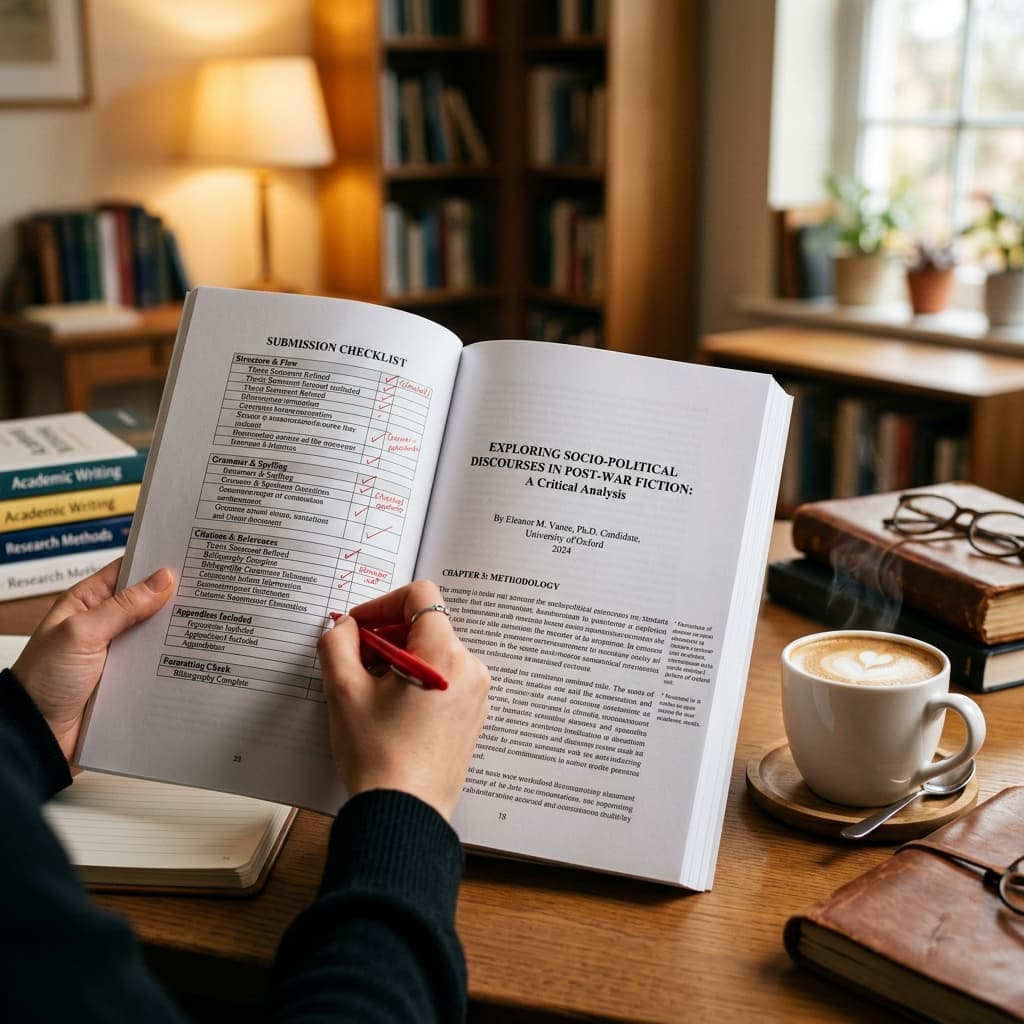
Start by identifying the help you need
Before comparing editors, decide whether your thesis needs proofreading, sentence-level editing, formatting support, or more than one service. These labels are not used consistently by every provider, so ask for a plain-language description of the work included.
List any non-negotiable requirements: preserve tracked changes, follow a style guide, review a specific chapter first, or return queries in a separate file. A clear brief makes proposals easier to compare.
Questions to ask before you book
A reputable service should be able to explain its process and limits without promising a grade, approval, or publication result. Ask questions that connect directly to your document and deadline.
- Which checks are included, and which are excluded?
- Will changes be tracked, and how will questions be marked?
- Can the editor work to the style guide or template I provide?
- What is the delivery date, and what happens if the scope changes?
- What file formats are accepted, and what will be returned?
- How are drafts stored, accessed, and removed under the service policy?
Check experience and subject fit
Subject familiarity can help an editor recognise field terminology, but it does not replace your own technical review. Ask whether the editor has experience with the document type and whether specialist terms will be queried rather than silently rewritten.
Look for transparent information about editorial standards, quality review, and author responsibilities. Be cautious of claims that imply an editor can guarantee institutional approval, fix research design, or validate the truth of results without examining the underlying evidence.
Confirm confidentiality and file handling
A thesis can contain unpublished work, personal details, or participant information. Review the provider's privacy terms and share only the material needed for the agreed task. If your university, funder, or ethics approval limits data sharing, follow those rules first.
Agree how files will be transferred and returned, who can access them, and how long they are retained. A secure upload process and a written privacy policy are useful signals, but read the actual terms rather than relying on a badge alone.
Prepare a brief that lets providers quote the same job
A clear brief should identify the document type, approximate word count, current draft status, deadline, requested service, English variety, and any required style guide. Mention whether the file includes footnotes, tables, figures, references, appendices, or tracked changes. If only certain chapters need work, explain that and attach a contents page so the provider can see how the sections fit together.
Include your most important priorities in plain language: for example, preserve discipline-specific terms, mark unclear claims for author review, or check heading and figure consistency. Do not send several competing drafts without saying which one is current. A precise brief helps providers describe the same work and makes their prices, timing, and deliverables easier to compare fairly.
Review a sample edit for judgment, not just polish
If a short sample edit is offered, look at whether the editor improves clarity without changing your meaning. Check technical words, cautious language, citations, and any sentence that states a result or limitation. A smooth sentence is not automatically a good correction if it strengthens a claim or removes a qualification that matters.
A sample should be small enough to protect your work and representative enough to show the editing approach. Ask whether it is free, how it will be handled, and whether the sample is included in a later order. Avoid sending confidential participant data or a chapter that your university restricts. The sample is one signal about process; it does not establish the quality of every page or guarantee that a full edit will meet an outcome requirement.
Check relevant experience and explain what it means
Ask whether the editor regularly works with theses, dissertations, or your document type, and how they handle specialist terminology. A qualification in a subject can be useful, but it does not automatically mean the editor is suitable for every discipline or every kind of review. Likewise, a general language editor may be effective at clarity while still needing you to confirm technical meaning.
Look for specific, verifiable descriptions of the editing process, relevant training, and editorial boundaries. If a provider names individual editors, check that the stated experience belongs to the person assigned to your work. Ask whether a second review or quality check is included, and what happens if the assigned editor is unavailable. Avoid treating vague claims such as 'expert in every field' as evidence.
Compare the full quote, not only the per-word rate
A useful quote states the service level, word-count basis, turnaround, currency, included files, and any fees or minimums. It should also clarify whether references, tables, appendices, captions, and supplementary files count toward scope. Two rates are not comparable when one includes formatting and another covers language only.
Ask what happens if the actual word count differs from your estimate or you upload a revised file. Confirm whether the provider will request approval before expanding the scope or charging more. If a quote is unusually low or high, ask what explains the difference. Do not choose based only on a headline price; compare the stated checks and deliverables with what your thesis actually needs.
Plan enough time for both editing and your review
The editor's delivery date is only one part of the schedule. You need time to read the changes, answer queries, consult a supervisor if necessary, update references or fields, and inspect the final file. A thesis with several chapters or complex formatting may require extra coordination even when the word count is familiar.
Share the fixed submission date and time zone, then ask when work would start and how late revisions affect delivery. Leave a buffer for file transfer or questions. If your content is still changing, agree which version will be edited and whether later additions can be reviewed. Booking a deadline with no time to review the returned file can make useful editorial work difficult to apply responsibly.
Agree how questions and revision requests work
Before booking, learn where to send questions, who will respond, and what response time to expect. Ask whether the editor will mark queries in the file, send a separate list, or both. Confirm whether a short clarification pass is included after delivery and what qualifies as a correction versus new editing on a revised chapter.
A clear communication process matters when the editor encounters ambiguous terminology or conflicting instructions. You should be able to provide an authoritative answer, and the editor should not guess. Keep the project brief and decisions in one thread or workspace so the current instructions do not get lost across several emails.
Choose the English variety and style guide that apply
Universities and departments may specify British, American, Canadian, Australian, or another English variety, as well as a citation style or formatting template. Do not assume the editor will infer the correct choice from the document. Tell the provider which guide applies and share the current version or link where possible.
If your department gives local exceptions to a published guide, include them. Ask whether the edit will standardise spelling, punctuation, dates, headings, and references, and whether quoted source titles or official names will remain unchanged. This is especially useful when chapters were drafted at different times or by several collaborators, because conventions can drift across a long document.
Be cautious of guarantees and unclear promises
An editor should not promise a passing grade, university approval, supervisor acceptance, or publication. Those decisions belong to examiners, institutions, supervisors, or journals. A language service can improve expression and perform agreed document checks; it cannot guarantee the quality of the underlying research or the outcome of an assessment.
Pause if the service will not explain what it edits, asks you to conceal permitted assistance, proposes writing assessed analysis for you, or cannot describe how your files are handled. Also be cautious when the quote omits timing or deliverables, or when a provider says it has checked every source without explaining what records were examined. Ask for clarification before sharing a full draft or making payment.
A practical scorecard for making the choice
Compare each candidate against the same short list: scope fit, subject and document experience, confidentiality terms, tracked-change method, delivery date, total price, communication, and files returned. Mark each item as clear, uncertain, or not offered. The scorecard does not need to be numerical; its purpose is to reveal missing information before you commit.
If two options look similar, ask the same follow-up question of both. For example, request confirmation about reference checks or tracked changes in writing. Choose the service that is transparent about both its capability and its limits. Keep the quote, brief, and privacy terms with your thesis records so you can refer back to the agreed work if questions arise later.
Compare proposals on the same basis
Send each provider the same file version, word count, instructions, and deadline. Compare the written scope, turnaround, total price, communication process, and deliverable format. The lowest quote may exclude checks you expected, while a higher quote may include a broader scope you do not need.
Once you choose, keep your original draft and review all returned changes. For a clear outline of our service, see [thesis editing](/thesis-editing), or [ask us about your document](/contact) before uploading.
Questions about this topic
Should I choose an editor with a degree in my subject?
Subject familiarity can help, but it is not the only factor. Confirm the editor's experience with your document type, their approach to technical terms, and the exact scope they provide.
Can an editor guarantee my thesis will pass?
No responsible editor can guarantee an academic outcome. Supervisors, examiners, and institutions make those decisions; editors can provide language and agreed document checks.
What should I send when requesting a quote?
Provide the document type, approximate word count, file format, deadline, service needed, and any style guide or special instructions.