
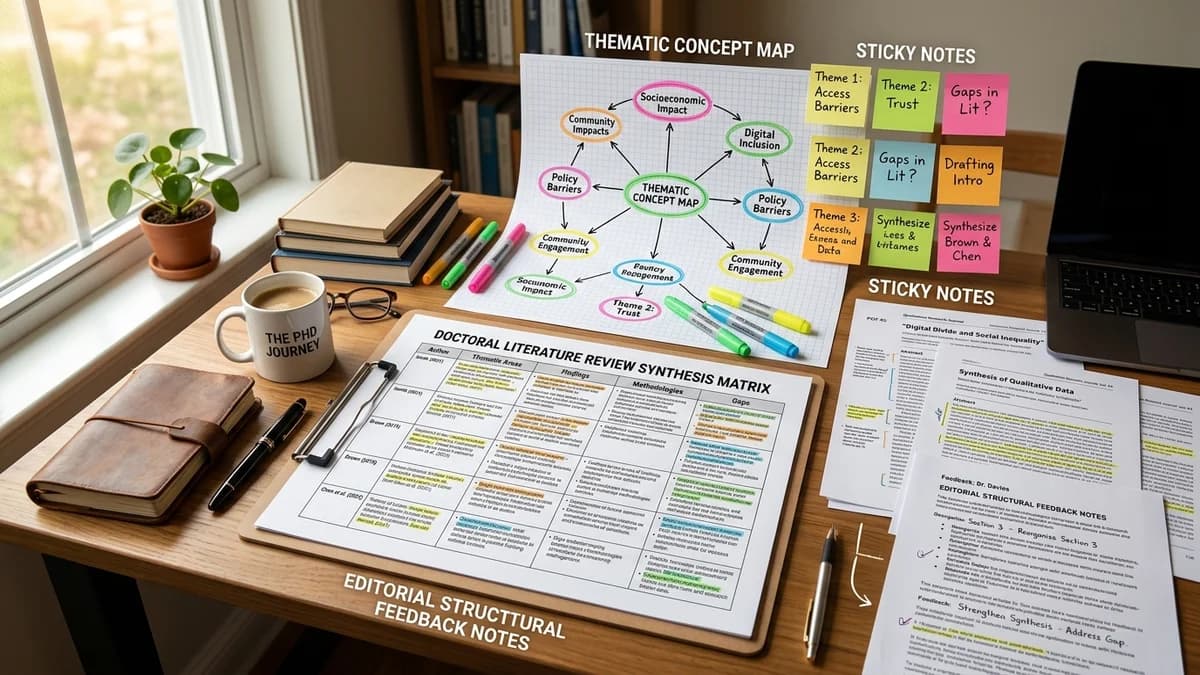
Why literature review editing is distinct from general proofreading
Editing an academic literature review requires assessing conceptual synthesis and argument trajectory rather than merely checking surface grammar. A literature review fails not because of misplaced commas, but because it degenerates into an annotated catalogue—a repetitive list of 'Author X said this, then Author Y found that'—without establishing thematic coherence, methodological critiques, or the research gap your dissertation addresses.
Professional literature review editing evaluates whether your authorial voice controls the narrative, whether paragraphs group findings by theoretical themes rather than individual studies, and whether your critique logically justifies your subsequent research questions. Polishing language without evaluating synthesis leaves the chapter structurally fragile.
The Golden Standard of Literature Reviews
Your literature review should never be an article-by-article summary. It is a critical, synthesized argument demonstrating where existing scholarship converges, where contradictions remain, and why your empirical study is necessary.
The 3-pass editorial framework for academic chapters
Attempting to resolve structural synthesis, sentence cadence, and referencing minutiae simultaneously creates cognitive overload. Professional academic editors utilize a structured three-pass framework:
- 01Pass 1: Macro-Structural & Synthesis Audit. Examine the chapter outline against your research questions. Confirm that subheadings reflect conceptual themes (e.g., 'Cognitive Load in Asynchronous Learning') rather than isolated authors. Identify redundant studies and check that every theoretical thread terminates in a clear research gap.
- 02Pass 2: Sentence-Level Clarity & Critical Voice. Revise passive constructions that obscure authorial perspective. Verify that topic sentences state your interpretive claim before introducing citations. Replace weak reporting verbs ('states', 'looks at') with evaluative verbs ('demonstrates', 'disputes', 'substantiates').
- 03Pass 3: Micro-Proofreading & Citation Verification. Confirm citation consistency (APA, Harvard, or Chicago), check direct quotes against page numbers, verify that every in-text citation exists in the bibliography, and eliminate typos in author surnames and technical terminology.
Transforming descriptive summaries into critical thematic synthesis
The most common supervisor critique is that a literature review is 'too descriptive'. Descriptive writing summarizes papers independently. Synthesized writing groups multiple studies around a shared theoretical claim, evaluates their methodological strengths, and exposes disagreements between scholars.
| Descriptive Draft (Weak) | Synthesized Revision (Authoritative) | Editorial Rationale |
|---|---|---|
| Smith (2021) investigated remote teams and found productivity dropped by 12%. Jones (2023) studied communication tools and reported high fatigue. Taylor (2024) argued asynchronous work improves output. | While early assessments indicated remote work decreased direct productivity by 12% (Smith, 2021), subsequent empirical investigations attribute this decline to communicative fatigue rather than physical separation (Jones, 2023). In contrast, recent longitudinal data suggest asynchronous communication protocols reverse these losses, improving net output across multi-time-zone teams (Taylor, 2024). | Connects three isolated studies into an evolving debate, highlighting causes and contrasting findings with clear academic transitions. |
| Brown (2020) used a survey of 50 students. Green (2022) conducted 10 interviews. Both concluded feedback was important. | Although methodological approaches range from quantitative surveys (Brown, 2020) to in-depth qualitative interviews (Green, 2022), scholarly consensus identifies timely formative feedback as the primary determinant of student engagement. | Synthesizes methodology differences while unifying their shared thematic conclusion. |
Optimising paragraph architecture: claims, evidence, and synthesis hooks
A well-crafted literature review paragraph follows a deliberate tripartite anatomy: the Topic Claim, the Evidentiary Dialogue, and the Synthesis Hook.
The Topic Claim opens the paragraph with your own scholarly interpretation. Never open a paragraph with an author citation ('According to Smith...'). Start with the thematic observation: 'Empirical evaluations of algorithmic grading reveal significant demographic bias in language assessments.'
The Evidentiary Dialogue presents two or more sources in conversation. Contrast their datasets, highlight regional differences, or demonstrate how recent studies build upon older frameworks. Conclude with a Synthesis Hook: a concluding sentence linking the evaluated evidence back to your thesis problem or preparing the reader for the next subheading.
Managing citation density: eliminating citation stringing and orphan claims
Citation density refers to the frequency and placement of source attributions within a paragraph. Editorial review frequently corrects two opposite extremes:
- Citation Stringing: Ending a broad sentence with five citations in parentheses '(Adams, 2020; Baker, 2021; Clark, 2022; Davis, 2023; Evans, 2024)'. While this proves you conducted reading, it provides zero critical analysis. Differentiate what each specific source contributed rather than stacking names.
- Orphan Claims: Bold, declarative assertions made without empirical support ('Modern organizations fail to understand artificial intelligence'). Every claim not stemming from your primary research requires direct scholarly attribution.
- Over-Quotation: Relying on extensive block quotations from other scholars. In doctoral dissertations, direct quotes should be reserved for legal definitions, unique phrasing, or primary historical texts. Paraphrasing demonstrates genuine mastery of the literature.
Scholarly transition matrix for building coherent arguments
Transitions between paragraphs and sections guide your supervisor and examiners through your logic. Use precise transitional expressions to signal relationships between disparate studies:
| Rhetorical Purpose | Recommended Scholarly Phrases | Phrases to Avoid |
|---|---|---|
| Contrasting Perspectives | Conversely; in sharp contrast; however, empirical replications dispute; this interpretation is contested by | On the other hand (cliché); but; also |
| Building Consensus | Similarly; corroborating this hypothesis; longitudinal evidence supports; aligned with this observation | Also; another person said; plus |
| Highlighting Gaps | Despite extensive documentation, research remains silent on; an overlooked variable is; methodological limitations leave unresolved | Nobody looked at; no one knows why; obviously |
| Evaluating Methodology | While methodologically constrained by small sample sizes; utilizing robust double-blind protocols; relying predominantly on self-reported data | Their paper had bad methods; it was poorly done |
Literature review pre-submission review checklist
Before sharing your literature review draft with your academic supervisor or committee, verify these criteria:
- Every section heading reflects a conceptual theme rather than a single author or study.
- The authorial voice leads each paragraph; citations support claims rather than driving the structure.
- At least 70% of citations reflect peer-reviewed literature published within the last 5-7 years, supplemented by seminal foundational works.
- All primary disagreements in the literature are balanced with objective, scholarly critique.
- The chapter concludes with a dedicated 'Summary of Gaps' section establishing the explicit rationale for your empirical methodology.
When to choose developmental editing vs final proofreading
If your literature review struggles with structural synthesis, missing transitions, or supervisor concerns about critical depth, a developmental or thesis editing service provides sentence-level restructuring and developmental queries.
If your chapter structure has received supervisor approval and you require a final check of punctuation, academic tone, style compliance, and citation accuracy, an academic proofreading service guarantees your submission is flawless.
Questions about this topic
How long should a literature review be in a PhD thesis?
A PhD literature review typically ranges between 8,000 and 15,000 words, comprising 20% to 25% of the total dissertation. Master's dissertation literature reviews usually span 3,000 to 6,000 words.
Can an editor rewrite my literature review for me?
No. Ethical academic editing guidelines strictly prohibit writing or generating content for assessed degrees. Professional editors improve clarity, flow, tone, grammar, and structure while leaving all intellectual arguments in the author's control.
How many sources should be cited in a literature review?
A doctoral literature review commonly cites between 100 and 250 peer-reviewed sources, balancing foundational seminal texts with recent scholarship. Master's dissertations generally cite 40 to 80 sources.
What is the difference between a literature review and an annotated bibliography?
An annotated bibliography lists sources individually with independent summaries. A literature review synthesizes sources into a coherent, thematic narrative that evaluates connections, contradictions, and gaps.