
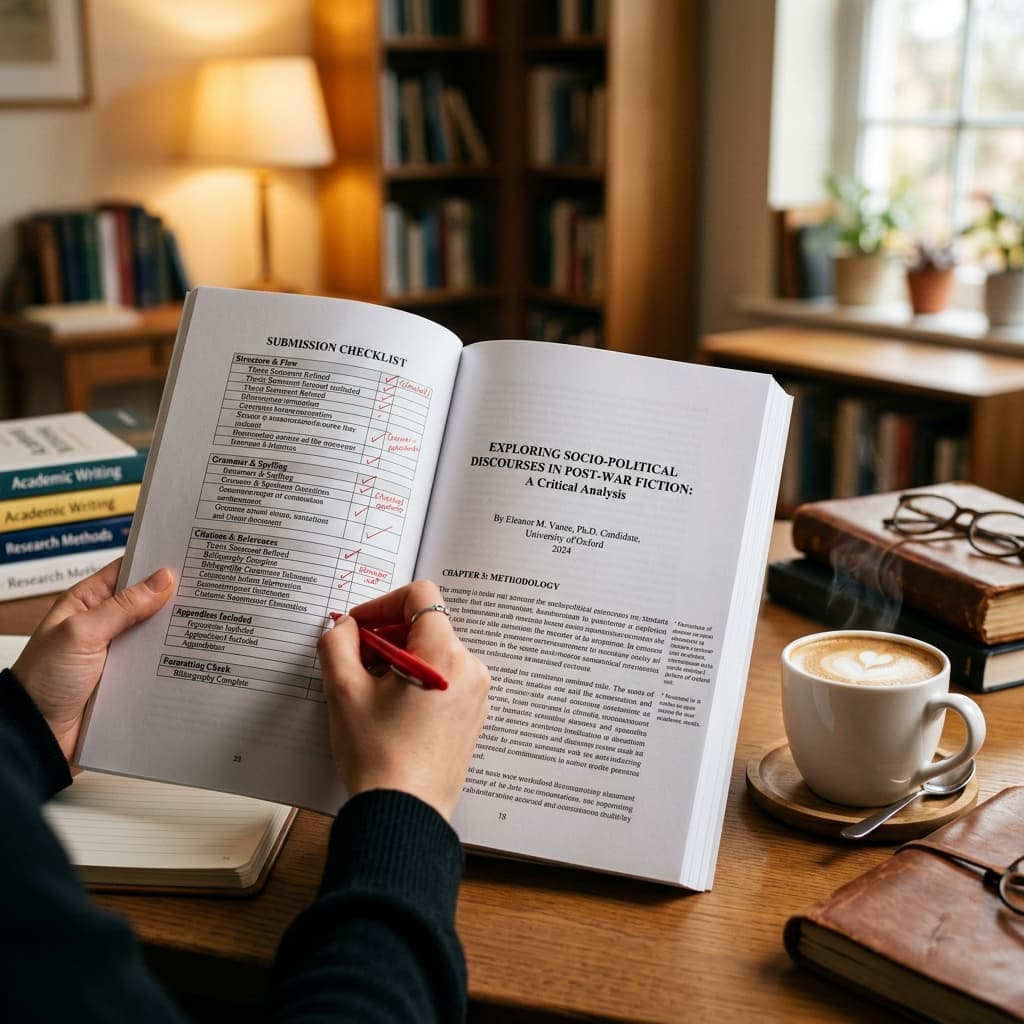
Master's dissertation proofreading checklist: quick overview
The final submission of a master's dissertation is a high-pressure moment. Small errors in grammar, inconsistent formatting, missing references, or an incorrect upload file can weaken the presentation of otherwise careful postgraduate work.
Use this 15-point dissertation proofreading checklist as a concise final control sheet after your main writing and supervisor revisions are complete. For a fuller schedule and step-by-step process, read how to proofread a dissertation. For a doctoral long-document review, use the PhD thesis proofreading checklist.
| Final check | What to review | Done |
|---|---|---|
| 1 | Grammar, spelling, and punctuation | □ |
| 2 | Sentence clarity and academic tone | □ |
| 3 | Repetition and unclear phrasing | □ |
| 4 | Chapter headings and structure | □ |
| 5 | Introduction and conclusion consistency | □ |
| 6 | Citations and reference list | □ |
| 7 | Tables, figures, captions, and numbering | □ |
| 8 | Page numbers, margins, spacing, and formatting | □ |
| 9 | UK or US English consistency | □ |
| 10 | Acronyms, abbreviations, and key terms | □ |
| 11 | Appendices and supporting documents | □ |
| 12 | Abstract as a standalone summary | □ |
| 13 | Supervisor, department, or university guidelines | □ |
| 14 | Final PDF or required submission file | □ |
| 15 | Second human review | □ |
1. Check grammar, spelling, and punctuation
Start your final dissertation check by focusing purely on language mechanics. Read through specifically to catch basic grammatical errors, spelling mistakes, and punctuation issues that software might miss.
- Ensure subject-verb agreement across complex sentences.
- Verify that commas, semicolons, and colons are used correctly.
- Check for homophone errors (e.g., affect vs. effect).
- Run a professional spell checker, but read manually for context errors.
2. Review sentence clarity and academic tone
Academic writing must be precise. Avoid overly complex sentences that confuse the reader. If a sentence requires multiple read-throughs to be understood, break it down. Maintain a formal, objective, and cautious academic tone, avoiding absolute claims unless fully supported by evidence.
3. Remove repetition and unclear phrasing
Students often repeat the same points across multiple chapters to hit word counts or reinforce arguments. Remove unnecessary repetition and vague phrasing. Ensure every paragraph introduces a unique point or clearly advances the central thesis.
4. Check chapter headings and structure
Compare your table of contents directly against the body of the dissertation. Ensure that heading levels are formatted consistently and that the structural hierarchy makes logical sense. If chapter order or argument flow still needs major work, use the step-by-step dissertation proofreading workflow before returning to this final checklist.
5. Review your introduction and conclusion for consistency
The introduction sets expectations, and the conclusion delivers on them. Read your introduction and conclusion back-to-back. Verify that the research questions posed in the introduction are definitively answered in the conclusion, and that no new information is introduced at the end.
6. Check citations and reference list formatting
A critical step in proofreading a dissertation is checking citation-reference consistency. Every in-text citation should have a corresponding entry in the reference list, and vice versa unless your university permits a separate bibliography. Follow your university's required style guide. The official APA reference guide provides excellent examples of standard formatting.
7. Review tables, figures, captions, and numbering
Check that all tables and figures are numbered sequentially (e.g., Figure 1, Figure 2). Ensure every visual element has a clear, descriptive caption and is explicitly referred to within the main text before it appears on the page.
8. Check page numbers, margins, spacing, and formatting
Formatting errors are easily spotted by examiners and suggest a lack of care. Verify that margins meet university guidelines, line spacing is consistent (usually 1.5 or double spacing), and page numbers follow the correct format (e.g., Roman numerals for front matter, Arabic numerals for body text).
9. Confirm UK or US English consistency
Mixing UK and US English spelling conventions is a common dissertation mistake. Choose one convention based on your university's location or guidelines, and apply it strictly. Check words like organize/organise, color/colour, and center/centre.
10. Check acronyms, abbreviations, and key terms
The first time you use an acronym or abbreviation, write the full term followed by the acronym in parentheses. From then on, use the acronym consistently. Consider including a List of Abbreviations in your front matter if your dissertation relies heavily on them.
11. Review appendices and supporting documents
Do not neglect your appendices. Ensure they are clearly labeled (Appendix A, Appendix B), formatted neatly, and correctly referenced within the main text. Remove any supplementary material that does not directly support your research.
12. Read the abstract separately
The abstract is often the first—and sometimes the only—part of your dissertation that people will read. It should be a flawless, standalone summary of your research question, methodology, key findings, and conclusions. Proofread it carefully as a separate document.
13. Check supervisor or university guidelines
Before the final dissertation check is complete, cross-reference your document with the specific submission guidelines provided by your department. Check required word counts, title page formats, and mandatory declarations of originality.
14. Do a final PDF check before upload
Submit the file type required by your institution; some universities request a PDF, an editable file, or both. Inspect the exact file you will upload for formatting shifts, broken links, unreadable figures, or blank pages introduced during conversion.
15. Get a second human review before submission
After months of looking at the same document, you will develop a blindness to your own errors. A second pair of eyes is essential. Whether it is a peer, a mentor, or a professional, another human review will catch mistakes your brain automatically corrects. Institutions like Purdue University's Writing Lab strongly recommend fresh perspectives when proofreading.
Common dissertation proofreading mistakes to avoid
Avoid relying entirely on automated spelling and grammar checkers, as they frequently misunderstand academic context and specialized terminology. Additionally, do not attempt to proofread the entire document in a single sitting; fatigue leads to missed errors. Finally, avoid making substantive structural changes during the proofreading phase, as this often introduces new typographical errors.
When should you use a professional dissertation proofreading service?
If your deadline is approaching, if English is an additional language, or if you want an independent final read, a professional dissertation proofreading service can check language, consistency, formatting, references, tables, figures, and presentation before submission.
Questions about this topic
What is included in dissertation proofreading?
Dissertation proofreading includes correcting grammar, spelling, punctuation, and typographical errors. It also ensures consistency in tone, terminology, formatting, and citation styles, making the final document professional and readable.
How long does it take to proofread a dissertation?
Turnaround depends on word count, draft condition, service scope, and formatting complexity. Documents above 50,000 words require a custom review so the editorial desk can confirm a realistic schedule and quote.
Should I proofread my dissertation myself?
You can perform the initial proofreading yourself using a checklist, but a second person can often catch errors that feel invisible after months with the same document. A peer, mentor, or professional proofreader can provide that final fresh read.
What is the difference between dissertation proofreading and editing?
Editing focuses on improving the structure, argument flow, clarity, and overall academic tone. Proofreading is the final step, focusing strictly on correcting surface-level errors like grammar, spelling, punctuation, and formatting consistency.
When should I get my dissertation proofread?
You should get your dissertation proofread only after all substantive writing, editing, and supervisor revisions are complete. Proofreading should be the absolute final step before creating your submission file.
Can proofreading improve my dissertation grade?
No. Proofreading cannot guarantee a grade, pass, approval, or outcome. It can improve clarity, correctness, consistency, and presentation so avoidable language and formatting errors do not distract from the work.